
.png?width=200&height=60&name=TrustLeader%20Logo%20Color%20(1).png "TrustLeader Logo Color (1)")

Everyone, CEO or business leader, instinctively knows that trust matters. But ask ten leaders to define it, and you will hear ten completely different answers. Some talk about reliability. Others talk about honesty. A few wave their hands in the air and call it a “feeling,” as if that is supposed to help you make better decisions on Monday morning.
After 25 years in B2B, I can tell you this: while most organizations care deeply about trust, they do not know how to describe it in operational terms. And if you cannot define something, you cannot measure it. If you cannot measure it, you cannot improve it.
In this article, I will not only give you a clear, practical definition of trust and explain why we have such a hard time defining it, but also provide a practical tool—the TrustLeader Compass—that helps you diagnose every key relationship in your business. When you understand how trust actually works, you unlock a new level of clarity in your sales, marketing, leadership, and customer relationships.
Why Trust Feels Fuzzy And Hard To Define
Trust is difficult to pin down because it is fundamentally subjective. Every person brings their own history, emotional wiring, and lived experiences to every interaction. Two people can experience the exact moment and walk away with entirely different levels of trust because their interpretations are shaped by what came before.
It is also contextual. Your level of trust is not the same with every vendor, colleague, or partner. It changes depending on what is at stake, the environment you are operating in, and the nature of the decision you are making. A quick approval for a $1,000 decision feels very different from committing to a multi-year contract.
Furthermore, trust overlaps with other concepts—confidence, faith, respect, even love. Because these ideas bleed into each other, it becomes hard to isolate what trust really is or how it behaves. And trust is dynamic: it evolves over time. It grows, it shrinks, it recovers, and sometimes it dissolves altogether when circumstances shift.
And finally, trust is relational. It only exists between people (or organizations). It is not something you can build alone in a vacuum. It is something that emerges from interaction—the tension between your intentions and someone else’s perception of those intentions.
A Clear Definition Of Trust In B2B Relationships
To make trust something we can measure, manage, and improve in business, we need a definition that goes beyond “reliability” or “honesty.” The most helpful one I have found comes from the social psychologists Mayer, Davis, and Schoorman, who describe trust as a willingness to be vulnerable in the face of risk.
In the TrustLeader Framework, as well as in the book, Lead with Trust, I define trust in business relationships as:
"Trust is the psychological state where our willingness to be vulnerable is equal or greater than the perceived risk of another’s actions, grounded in the belief that they will fulfill our positive expectation without our direct control or oversight."
That is the key: trust is a psychological state created by the tension between two variables—your willingness to be vulnerable and your perception of risk.
Your willingness to be vulnerable is internal. It is the degree to which you are open to uncertainty, the costs you are willing to absorb, and the risks you are comfortable taking. Perceived risk is external. It is how dangerous or costly the other party’s potential actions feel to you.
In the TrustLeader Framework, we refine this definition into a practical rule you can use: Trust happens when your willingness to be vulnerable is equal to or greater than the perceived risk. If the risk feels too high—or if your willingness to be vulnerable is too low—trust does not form. It is as simple and as complicated as that.
Why This Definition Matters In B2B Relationships
Business buyers are not just weighing features and benefits; they are weighing risk. Will this fail? Will this make me look bad? Will this cost more than I can justify? Will this put my team behind? Will this reflect poorly on my judgment?
This is why trust becomes the deciding factor—not price, not product, not personality. It determines whether buyers move forward, stall, or walk away entirely. Research shows that 81% of B2B buyers will not buy from brands they do not trust, and 71% will stop buying after a single breach of trust. High-trust relationships, on the other hand, dramatically increase retention and advocacy.
When you understand trust as a calculation—vulnerability versus perceived risk—it becomes far easier to influence. You can reduce risk. You can increase confidence. You can create conditions that make your buyers feel safe enough to move forward.
The TrustLeader Compass: A Practical Tool For Diagnosing & Directing Trust
The TrustLeader Compass maps the interaction between vulnerability and perceived risk across four directions. Think of it as a snapshot of where a relationship currently sits—and which direction you need to move to build deeper, more strategic trust.
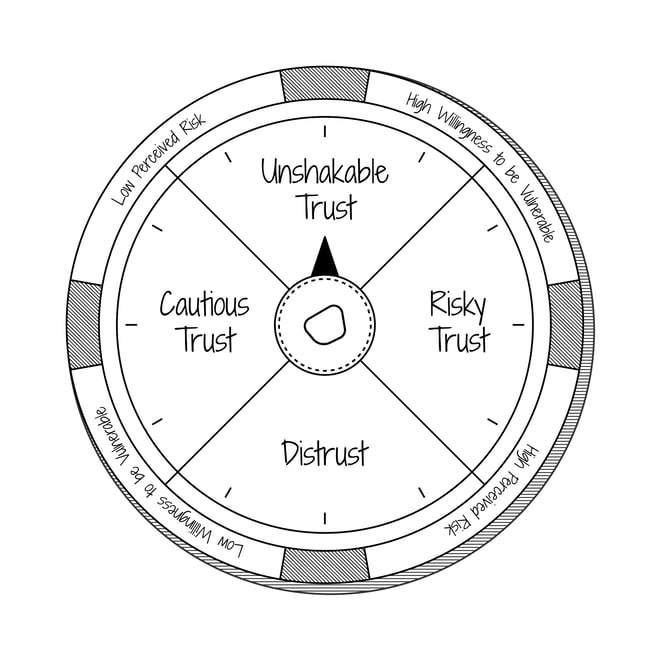
South — Distrust: Low Vulnerability, High Perceived Risk
In the distrust quadrant (south), every interaction feels defensive. You are unwilling to be vulnerable, and the perceived risk is high. This is where relationships break down, decisions stall, and communication becomes transactional and tense. Nothing moves easily here because fear runs the show.
Example: Imagine working with a supplier who has missed critical deadlines in the past. Now every milestone requires legal review. Every promise triggers skepticism. You are constantly double-checking their work because one more slip could damage your business. That is the South.
East — Risky Trust: High Vulnerability, High Perceived Risk
In the risky trust quadrant (east), you are willing to trust, but you feel uneasy doing so. You believe in the potential, but the stakes are high and the path is uncertain. Risky trust is filled with hope and a little anxiety. It is where innovation can happen—but also where things can go sideways quickly.
Example: Think of a startup choosing a brand-new, unproven technology vendor because the promise is transformational. The value could be enormous, but the vendor has no track record. The startup chooses to lean in anyway, knowing full well the risks.
West — Cautious Trust: Low Vulnerability, Low Perceived Risk
In the Cautious Trust quadrant (West), things are somewhat stable but not deep. You trust the other party to do the basics, but not much more. The risk is low, but so is your willingness to open up or invest emotionally. These relationships are functional, reliable, but easily replaceable.
Example: This might be your standard month-to-month service provider. They do their job. You pay the invoice. Everything works. But if a better option appeared tomorrow, switching would be easy. There is trust, but not loyalty.
North — Unshakable Trust: High Vulnerability, Low Perceived Risk
Finally, let's talk about Unshakable Trust (North). This is the goal. This is where unshakable trust lives. You feel completely confident in the other party’s intentions and capabilities. You are willing to be vulnerable and the perceived risk is low. This is where advocacy, loyalty, and long-term partnerships thrive.
Example: Think of the partner you would sign a multi-year contract with without blinking. If something goes wrong, you assume they will fix it. You recommend them publicly. You defend them when others criticize. They have earned a level of trust that feels effortless and mutual.
Reflection: Where Are You On The Compass Today?
Take one key relationship—a top customer, a strategic partner, or even an internal revenue-critical relationship—and map it on the Compass. Where does it sit? Are interactions defensive or transactional? Are they hopeful but uneasy? Are they stable but shallow? Or are they built on deep, predictable, unshakable trust?
Once you locate the relationship, ask yourself one question: What single action would move this relationship one step north? Sometimes, it is more transparency. Sometimes it is better communication. Sometimes it is improving reliability, or reducing friction, or simply owning a mistake more openly. Trust is dynamic, and small actions create meaningful movement.
Conclusion: Trust Is Measurable—And, Therefore, You Can Manage It
Trust is not mysterious or fluffy. It is measurable, mappable, and entirely influenceable. When you understand trust as the balance between vulnerability and perceived risk, you gain a practical way to diagnose relationships and guide them toward deeper, more transformative partnerships.
Use the TrustLeader Compass to evaluate your customer journey, your sales process, your policies, and your communication. If something creates high risk and low vulnerability, move it. If something pushes you toward the North, double down.
And here is your challenge: Map one key client or partner relationship today—and choose one action that would move it one step north. When you build trust intentionally and systematically, everything else becomes easier.
If you want a deeper diagnostic of where you are at today in terms of trust building (and identify potential gaps), begin with the TrustLeader Assessment:
Sources:
- Edelman. Edelman Trust Barometer 2023–2024. Edelman, 2024.
- Eisenberg, Hannah. Lead With Trust. Chapters 10–12., 2025.
- Forrester Research. Customer Experience & Loyalty Data. Forrester, 2023.
- Gartner. B2B Buyer Behavior Research. Gartner, 2024.
- Mayer, Roger C., James H. Davis, and F. David Schoorman. “An Integrative Model of Organizational Trust.” Academy of Management Review 20, no. 3 (1995): 709–734.
.jpg)
Lead, or Be Prepared to Follow: Marcus Sheridan on Leading With Trust
If you’re a CEO or marketing leader feeling like everything that used to work suddenly doesn’t — you’re not imagining th …
The Founder’s Playbook To Transparency When You Are Selling Without Control
If you are a founder or CEO in B2B today, you have to figure out how to solve a very specific and very uncomfortable pro …

You Don’t Have A Lead-Gen Problem. You Have A Trust Problem.
Yesterday, I spoke to David, a CEO in the packaging industry. Halfway through the conversation, he said, “Hannah, everyo …
No Comments Yet
Let us know what you think