Ultimately, there is one factor in every B2B purchase. It's not product features. Not brand promises. Not even price. It's trust. If a buyer does not feel confident enough to take the risk, they will default to the safest option they trust most—even if that means doing nothing or a buying from a vendor that isn't the perfect fit but makes them feel safer. In the 2023 Forrester Business Trust Survey, "an astonishing 43% of B2B buyers admitted that they make defensive purchase decisions more than 70% of the time."
The problem is that, from where you are sitting, this might look like a sales or marketing problem because you will never know that they didn't go with you because they trusted another competitor more, despite the lack of some features. As a loss reason, the prospect would never say, "We didn't trust you enough, so we went with the other guy."
After 25 years in B2B—working with SAP for more than a decade, consulting with mid-market companies, and building the TrustLeader methodology—I’ve seen the same pattern repeat across industries. We all know trust is essential, but we don't invest in it because it's fuzzy. Hard to define. Hard to operationalize. Hard to measure. Which means trust remains a hope, not a process. And as my old boss at SAP would say: "Hope is not a strategy."
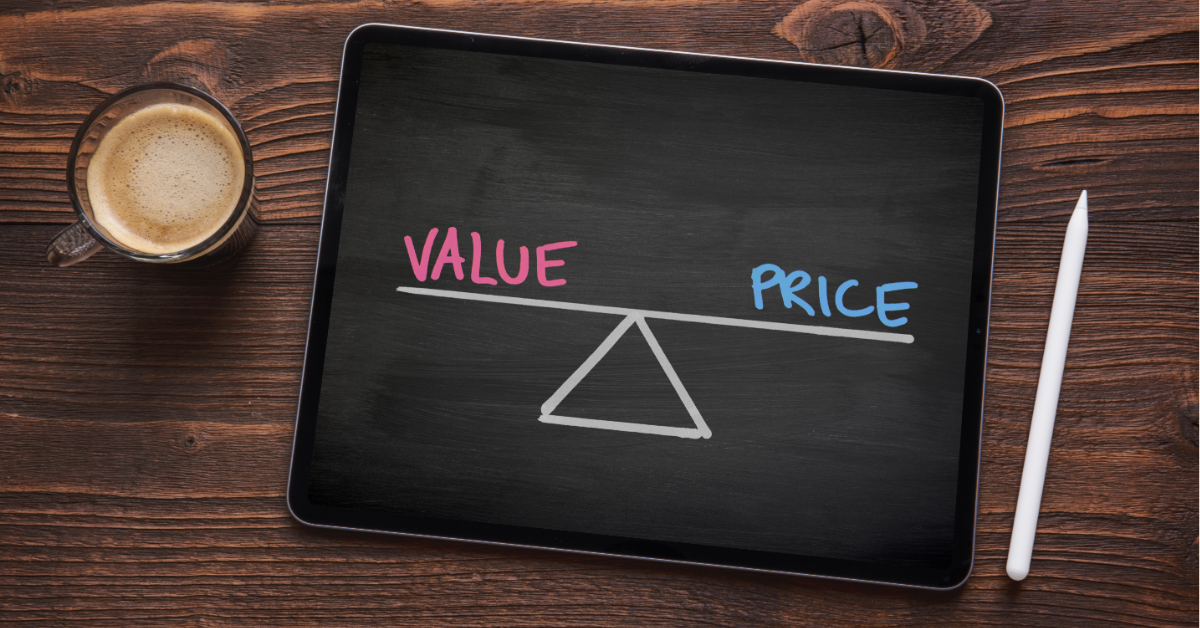
In 2024/2025, I set out to change this. I developed the TrustLeader Framework and wrote my book, Lead with Trust, to give leaders a step-by-step methodology for intentionally and systematically building trust. A core concept within the book is the Trust Seesaw. It is a mental model that gives you a clear way to understand why buyers hesitate, what’s holding them back, and how your company can move from distrust as the default all the way to unshakable trust.
This article will walk you through the Trust Seesaw model. By the end of this article, you’ll understand:
-
The three reasons buyers feel distrust by default,
-
What must be addressed before trust can exist at all,
-
How to reach Trust Equilibrium—where buyers finally feel confident and in control, and
-
What it takes to go beyond equilibrium and earn a true Trust Advantage.
Let’s start where every buyer starts: with hesitation.
Why Distrust Is Your Buyers' Default Emotion Today
When a buyer is considering your solution, they are not comparing your features. They are weighing risk.
“Do I have enough confidence to move forward?”
"Will this solution work as promised?"
"What if there are any issues?"
“Do I believe this vendor has my best interest in mind?”
“Do I feel in control of this decision?”
If the answer to any of these questions is no, your buyer becomes weary and the deal slows down, stalls, or collapses.
The Three Deficits That Create Distrust
Three specific barriers are driving your buyer's hesitation:
- They lack clear information.
- They doubt your intentions.
- They fear losing control.
These three barriers form what we call the Information Deficit, Interest Deficit, and Power Deficit. Think of them as heavy weights sitting on one side of a seesaw, pushing it down into distrust. If you don’t remove or counterbalance these deficits, no amount of sales skill or marketing polish will build trust.
Let’s break them down.
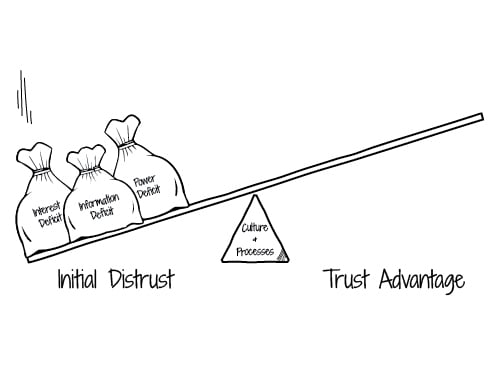
1. Information Deficit: “I Don’t Have What I Need to Decide.”
Buyers face a strange contradiction. They have endless content available online, yet very little of it is truly helpful. Much of it is vague, incomplete, or written from the seller’s perspective, not the buyer’s.
What they want is clarity:
-
What will this cost me?
-
What trade-offs am I making?
-
What should I watch out for?
-
How do I compare options?
-
What does success realistically look like?
When they can’t find this clarity, uncertainty grows. And uncertainty delays decisions.
2. Interest Deficit: “I’m Not Sure You Have My Best Interest at Heart.”
Buyers assume companies have agendas. Past experiences have taught them to expect:
-
Upsells pushed too early
-
Recommendations that favor the vendor
-
Pressure to move faster than they are ready
-
Hidden downsides they’ll discover later
Even if you don’t operate this way, the buyer has no evidence of that yet. Their default assumption is that your goals may not align with theirs.
And skepticism is the natural result.
3. Power Deficit: “You Hold the Cards. I Hold the Risk.”
Buyers know vendors control the pricing, contract terms, information flow, and access to expertise. When they feel they have little influence over the rules, fear enters the process:
-
“What if this locks us in?”
-
“What if this becomes more expensive later?”
-
“What if something goes wrong and we’re stuck?”
This fear is one of the most common reasons deals stall—far more often than budget.
These three deficits create distrust. But the good news is that they can all be addressed systematically. And when you do this, something powerful happens.
The seesaw begins to level.
Overcoming Distrust By Overcoming The Three Deficits: Reaching Trust Equilibrium
Trust Equilibrium is the point where buyers feel informed, understood, and empowered. It’s the level of trust they expect every responsible company to operate at.
Fun fact: Most companies are not operating in this state as they do not build trust intentionally and systematically, and without operationalizing this, they never will.
But you can—by applying three core principles that counter the three deficits.
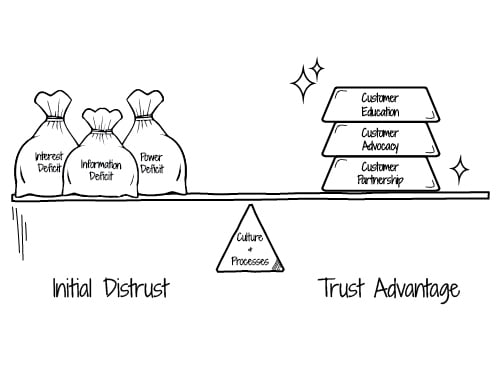
A. Closing the Information Deficit Through Complete Transparency
Your first responsibility is to give buyers the clarity they need to evaluate their options. This requires complete transparency. In your day-to-day business activities, this means:
-
Answering the real questions buyers have transparently, honestly, and in an unbiased way.
-
Addressing potentially contentious topics like pricing, comparisons, risks, and drawbacks.
-
Offering tools that support sound decision-making.
-
Sharing information consistently across your website, sales process, and content.
There are many ways to do this. One strong example is building content around the “Big 5” questions that buyers always ask. But it is not the only way. The goal is to remove uncertainty by giving buyers what they need to make a confident, informed decision.
If you do this, your buyers feel prepared and supported. They understand their options and can explain their decision.
Quick Win: Identify the top 10 questions that buyers repeatedly ask, and then answer them clearly on your website and in your sales materials.
B. Closing the Interest Deficit Through Unapologetic Customer Alignment
The second barrier to trust is the buyer’s belief that you may be acting in your own interest rather than theirs. To close this deficit, you need more than good intentions. You need unapologetic customer alignment—a principle that guides how you show up in every conversation, recommendation, and decision. This means:
- You invest the time to understand what your buyer is trying to achieve, what is holding them back, what they fear, and what a successful outcome actually looks like from their perspective. You listen without rushing. You ask questions that help them clarify their goals. You acknowledge their concerns without dismissing them.
- You show real respect, not just politeness. It includes protecting their information, respecting their time, and communicating with clarity. It means you don’t pressure them into decisions they’re not ready to make. You give them the space to process the information you provide, and you support their pace, not yours.
- You act with their best interest at heart—even when it does not benefit you. Sometimes that means recommending a competitor because they’re a better fit. Sometimes it means advising a prospect not to buy at all because the timing is wrong or the problem isn’t clearly defined. Benevolence signals that you care about their outcome, not just your revenue.
When you align your actions with empathy, respect, and benevolence, something shifts. The buyer begins to see you not as a vendor trying to win a deal, but as a partner helping them make a good decision.
Your buyers recognize that your recommendations are grounded in their interests, not yours. You earn the status of a true customer advocate—someone they can trust to guide them honestly, transparently, and responsibly.
Quick Win: Identify one moment in your sales process where you could slow down, ask better questions, or clarify risks and trade-offs. Use that moment to demonstrate alignment with the buyer’s goals rather than your own agenda.
C. Closing the Power Deficit With Unwavering Ethical Conviction
Last but not least, your buyers feel that you hold all the power, while they take on all the risk. To overcome this third deficit, you have to lead with what we in the TrustLeader Framework call unwavering ethical conviction, which means holding firmly to ethical principles and fair practices—even when it’s inconvenient. This includes:
-
Clear, plain-language terms
- Eliminating unfair industry practices
-
Transparent and fair pricing
-
Reasonable cancellation policies
-
Options that give buyers control
-
Internal consistency: no notable exceptions behind closed doors
This signals stability, fairness, and predictability—three things buyers rarely expect but deeply value. Under these conditions, buyers feel they have a voice and a level of control, which reduces the fear that blocks decisions.
Quick Win: Review your contract for hidden risks or unclear terms, and revise one section to be more buyer-friendly.
What Trust Equilibrium Looks Like
Once you close the three deficits, buyers feel:
-
Informed
-
Understood
-
Supported
-
Empowered
You have reached Trust Equilibrium—the baseline for a trusted business. You are now building trust intentionally and systematically, and your buyers and customers will thank you for it. Decisions move forward with less resistance. Sales cycles shorten. Conversations feel easier. Customer loyalty increases.
Every company has the potential to reach this point. And every company should aim to reach this point because this is the level your customers expect you to operate in!
While the payoffs and benefits are tremendous when you reach this stage, you don’t have to stop there. For some companies, the journey isn't done yet. There are some businesses born to lead. If that is you, read on because here is where the magic happens.
Going Beyond Equilibrium: Tipping the Seesaw Into Trust Advantage
Trust Advantage is rare. Only a small percentage of companies ever reach this stage. But when you do, buyers seek you out. They pay a premium. They prefer your approach to the industry’s defaults.
This requires elevating the same three principles to their advanced form.
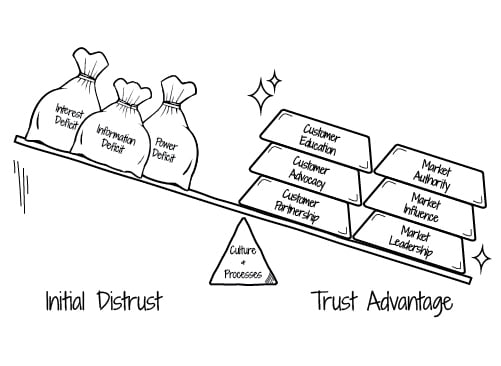
A. Moving From Customer Education To Market Authority
Being the market authority means you are recognized as the most reliable source of clarity in your space. You are the best teacher in your industry. If someone wants to know something about your space, they seek you out because they know you are the go-to expert.
This looks like:
-
You actively demonstrate your expertise and competence by developing unique IP, such as frameworks, maturity models, methodologies, and more.
- You can prove your reliability transparently and publicly. You have standardized many of your processes and implemented innovations that make you far superior and more dependable than your competition.
- You live and breathe your company values. This not only highlights your extraordinary integrity, but also results in your buyers feeling reassured that you will come through on your promises.
When your market turns to you first to understand a topic, you’ve reached market authority.
B. Moving From Customer Advocacy To Market Influence
Next, we have to turn interest parity into something that creates a trust advantage for us. Essentially, you focus on what is right for customers, which shapes the broader industry conversation. You redefine and raise the standards, expectations, and norms of your industry by taking public positions that defend and advance customer interests.
Below are some examples of what this would look like in practice:
-
You identify a commonly accepted practice that harms customers—and you speak out about it clearly and consistently.
- You establish practices that protect customer interests and then openly challenge your industry to do the same.
- You expose the patterns, traps, and misunderstandings that cause buyers to make poor decisions.
- You make your ethical position visible—and consistently reinforce it.
-
You define what customers should expect next—and why the current state is no longer acceptable.
At this level, the market sees you as the ethical benchmark and a driver for good. You now have achieved the status of market influence.
C. Moving From Customer Partnership To Market Leadership
Finally, we elevate power parity into a true trust advantage. This is where you move beyond fairness and transparency and begin ethically reshaping the market itself. You no longer just participate in your industry—you redefine it by rewriting outdated rules, challenging entrenched norms, and empowering customers in ways competitors are unwilling or unable to match.
Trust-based market leadership is rooted in shared values, ethical conviction, and a long-term commitment to doing what is right—even when it requires difficult choices. When you lead this way, you create a loyal community around your mission, not just your product.
Below are some examples of what this looks like in practice:
-
You eliminate outdated or unfair terms that the industry takes for granted—and replace them with modern, customer-empowering alternatives.
-
You build pricing models, service structures, or engagement rules that shift control back to the customer.
-
You openly challenge practices that limit customer autonomy, and you demonstrate better, more ethical approaches through your own operations.
-
You use your values as a filter for decisions, consistently prioritizing what strengthens long-term trust over what delivers short-term gain.
-
You create a clear identity—a shared ethos—that attracts customers who share your beliefs and remain loyal because of it.
At this level, you are no longer just influencing the conversation—you are shaping the landscape. You become a trust-based market leader whose principles, policies, and practices set the standard others eventually follow.
What The Trust Advantage Looks Like (The Payoff)
When you reach the Trust Advantage, buyers no longer view you as one option among many—they view you as the default choice. Your reputation for clarity, alignment, and ethical leadership creates a decisive gap between you and the rest of the market. Buyers feel safer with you because you have consistently reduced their risk. They feel more confident with you because you’ve consistently guided them well. And they feel more respected by you because you have built a system that elevates their control, not diminishes it. As a result, they actively seek you out instead of waiting for you to pursue them.
In this state, price becomes less of a deciding factor. Customers are willing to pay a premium—not because you are the most expensive, but because you are the least risky. Your influence shapes how buying decisions are made, how competitors position themselves, and how industry standards evolve. Stakeholders trust your judgment. Competitors watch (and often imitate) your moves. And internally, your team operates with clarity because they understand what you stand for and how to deliver on it.
Over time, the Trust Advantage compounds. You attract better-fit customers, retain them longer, and create a community that believes in your mission as much as your solution. This is where unshakable trust lives: in the space where your values, actions, and outcomes are so aligned that customers would rather adjust to your way of working than risk working with anyone else.
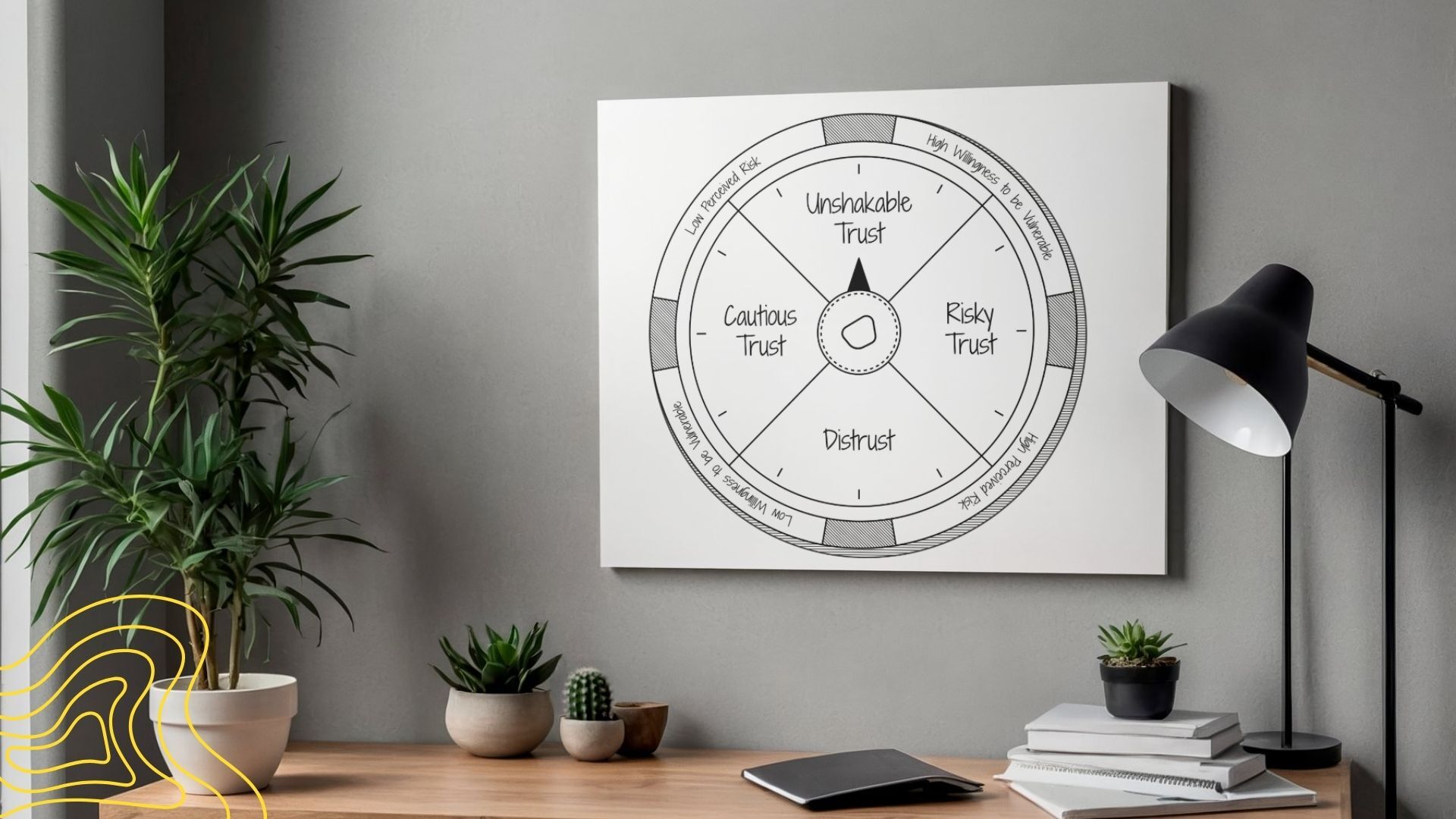
In the TrustLeader Framework, we also call this "Unshakable Trust."
The Fulcrum: Culture and Processes
If you ever played on a seesaw as a kid, you know that the position and structure of the fulcrum are essential. The seesaw doesn’t move on its own. It sits on a fulcrum made of two things:
-
Culture: the behaviors people default to when no one is watching, and
-
Processes: the routines that make trust-building consistent and repeatable.
If either one is misaligned or not strong enough, the seesaw gets stuck. Trust becomes inconsistent and fragile. But when culture and processes reinforce customer education, advocacy, and conviction, your trust-building efforts scale across the entire organization—reliably, repeatedly, and measurably.
Ready To See If You Have What It Takes To Lead Your Market?
If this article sparked something in you—a sense that your company could be doing more, leading more boldly, or stepping into a position your competitors can’t touch—then the Trust Leadership Scorecard is your next step. It’s designed to help you understand your potential for becoming the kind of market leader others will follow. In just ten questions, you’ll see where your strengths are, where untapped opportunities lie, and what might be holding you back from rising to the level of influence and authority that your company is capable of.
It takes less than two minutes, it’s completely free, and your results are delivered instantly. If you know you’re not yet operating at your full potential—and you’re ready for a clear picture of what the journey ahead could look like—the scorecard will show you exactly where your opportunity begins.

.png?width=200&height=60&name=TrustLeader%20Logo%20Color%20(1).png "TrustLeader Logo Color (1)")


No Comments Yet
Let us know what you think