
.png?width=200&height=60&name=TrustLeader%20Logo%20Color%20(1).png "TrustLeader Logo Color (1)")

You have read the output. You have rewritten it. You have sent it back to the team with notes. And somewhere in the back of your mind, you have started to wonder whether the problem is the tool, the prompt, or the person writing the prompt.
It is none of those things.
I have worked with B2B CEOs across growth-stage companies for more than a decade. I wrote *Lead With Trust* (2025) specifically about the gap between AI adoption and AI foundation. And I see the same pattern repeat across every sector, every team size, every tool stack: the output is generic, occasionally wrong about your own products, and sounds like it could have come from any company in your category. Because, structurally, it could have.
Why does AI keep producing output that doesn't sound like you — even when you write a careful prompt?
That is what this article is about.
Before I go further: TrustLeader helps organizations extract, codify, and structure intrinsic knowledge and context, and build AI-accessible knowledge bases for a living. We have a direct financial interest in the conclusion reached in this article. So I am going to show you all three levels honestly — including where a bare prompt is entirely appropriate and where a full knowledge base is premature — because the goal is the right answer for your situation, not a sale. This article defines the AI Context Gap, walks through the three levels of context, and provides a concrete benchmark for where your business sits today.
What is the AI Context Gap?
Definition: The AI Context Gap is the distance between what your AI knows about your business and what it actually needs to know to accurately represent you.
AI is not an oracle. It is a generative algorithm that predicts the next statistically likely word based on patterns in its training data. It is confident by design — even when it is wrong. This is not a flaw in the tool. It is how the tool works.
When AI does not know something specific to your business, it does not stop. It fills the gap — from general internet patterns, from inference, from statistical approximation. This is the root of hallucination. The AI is not lying. It is doing exactly what it was built to do: produce the most plausible next word, given what it knows.
The wider the gap, the more the AI is writing about a business it invented. The output will always arrive. The question is whether it is actually yours.
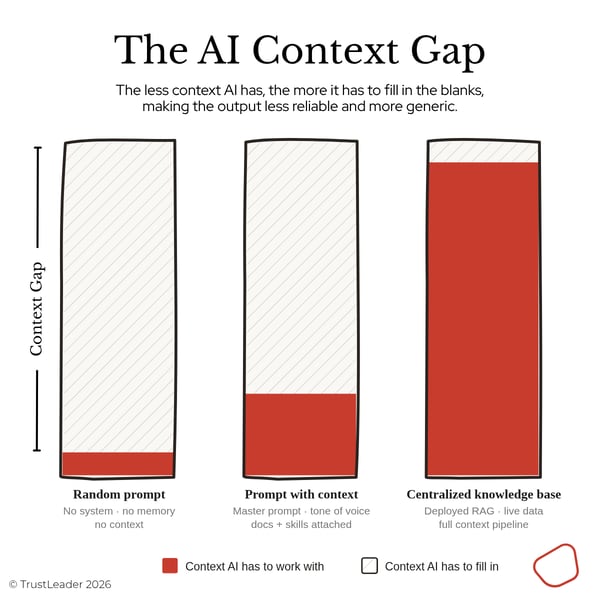
The three-cylinder graphic makes this visible. Each cylinder represents one level of context. The gap is not abstract — it is measurable, and it shrinks as you move from left to right.
Level 1: AI Has Nothing Other Than The Prompt Itself To Work From (Bare Prompt)
A bare prompt is a prompt with no system context, no memory, and no grounding in your business. The AI works from general internet knowledge to approximate what you probably mean. The AI Context Gap is nearly total at this level. Output is generic, inconsistent, and frequently hallucinates specifics — product names, pricing, differentiators — it has no basis for.
This is not a prompt-writing problem. A better prompt cannot fix the absence of documented knowledge. If your expertise is not written down in a form AI can access, no prompt will produce output that sounds like you. Think of it this way. You would not send a new hire to a customer meeting on day one without a briefing. A bare prompt is exactly that — except the intern is attending ten thousand meetings simultaneously, and every gap gets filled with confident improvisation.
This level is appropriate for low-stakes, non-brand-specific tasks: summarizing a public document, drafting a calendar invite, and reformatting a spreadsheet. It is not appropriate for anything customer-facing, brand-adjacent, or product-specific.
Level 2 — Prompt With Context: Better, But Still A Gap
Prompt with context means adding a master prompt, a tone-of-voice document, brand guidelines, or project-level supporting materials. The AI Context Gap narrows meaningfully at this level. Output sounds more like the brand, references the right terminology, and stays closer to the intended message.
But the limitations are structural — not fixable by adding more text to a prompt:
-
Context goes stale. Products change. Messaging evolves. Campaigns launch. The document you loaded last quarter is already behind.
-
Teams diverge. One person uses last quarter's positioning. Another uses the updated version. Output is inconsistent across the same team.
-
Context windows have ceilings. Long documents get truncated or deprioritized. The AI does not always read everything you give it.
-
There is no retrieval. The AI cannot go find what it needs. It only works with what you manually include each time.
This is Scattered AI with better inputs. It is an improvement. It is not a system.
Prompt with context is appropriate for small teams, early-stage AI exploration, and low-volume content needs. It is not appropriate for scale, consistency across teams, or any workflow where accuracy is non-negotiable.
Level 3 — Knowledge Base with RAG: Closing The Gap
RAG (Retrieval-Augmented Generation) is a method by which AI dynamically retrieves relevant information from a structured knowledge base before generating a response, rather than relying solely on its training data or what was manually included in a prompt.
A knowledge base in this context is a managed, structured repository of your documented brand voice, product and service context, customer evidence, competitive intelligence, and campaign materials, structured and organized in a way that makes it easy for the AI to retrieve the relevant information.
With RAG, the AI Context Gap closes. Output sounds like you, accurately describes your products, stays on-brand, and does not invent what it does not know. Every user on the team works from the same source of truth.
A properly managed knowledge base contains, for example:
-
Voice and tone documentation
-
Product and service descriptions (accurate, current)
-
Ideal customer profile and buyer insight
-
Sales methodology and objection handling
-
Customer evidence (case studies, testimonials, proof points)
-
Competitive intelligence
-
Campaign kits and messaging frameworks
-
Governance rules (what requires human review, what counts as accurate enough)
This is Scaled AI. The foundation is built. The output is trustworthy.
One honest note: if the knowledge does not exist in documented form, a knowledge base cannot be built from nothing. In the TrustLeader Method, Extract and Codify come before Structure. You cannot skip to the third move before the first two are done.
What Is The Real Business Risk Of The AI Context Gap?
The AI Context Gap is not an AI problem. It is a business risk that scales with AI usage. This includes specifically:
-
Off-brand copy that erodes the voice you spent years building,
-
Incorrect product claims that create legal and trust exposure,
-
Content that sounds like every competitor, because it was trained on the same internet they were on,
-
Expensive rework cycles that eliminate the efficiency gains AI was supposed to deliver, and
-
Trust breaches that are hard to trace back to their source.
Coming back to the intern analogy. One new hire attending one meeting without a briefing is an annoyance. Ten thousand simultaneous meetings, every gap filled with confident improvisation — that is a brand problem. The gap that was manageable at low volume becomes catastrophic at AI scale. This is a documentation failure that shows up as an AI failure. The tool is doing exactly what it was designed to do. The problem is that nobody wrote down what good looks like.
Do You Need A Knowledge Base Yet (And When It's Not Yet The Right Fit)
A knowledge base requires documented knowledge to exist first. If your voice, methodology, product context, and customer insight live in the founder's head or in scattered files, the Structure step cannot precede Extract and Codify. That is the sequence the TrustLeader Method exists to enforce, and skipping it does not save time. It just moves the failure downstream.
If you are a solo operator or a very early-stage company with minimal content volume, the overhead of a full knowledge base may outweigh the benefits right now. Also, if your team is not yet consistently using AI, governance infrastructure is premature. Build the habit before building the system. The right entry point in these cases: start with a master prompt and a tone-of-voice document (Level 2), while simultaneously beginning to document your expertise. The goal is to move toward Level 3, not to skip there before the foundation exists.
One more thing worth saying directly: TrustLeader is not the right fit if you want to outsource the thinking. The TrustLeader Method requires the client to participate in the extraction process. If the goal is to hand it off and walk away, this is not the right engagement.
How to decide which level is right for your business now
Here are three questions I encourage you to ask yourself (in that order):
-
Is your expertise documented in a form AI can access? If no, start with Extract and Codify before anything else. No amount of prompting fixes undocumented knowledge.
-
Is your team using AI consistently across multiple workflows? If no, Level 2 is appropriate while you build the habit.
-
Are you experiencing inconsistent output, off-brand content, or rework cycles at scale? If yes, you have outgrown Level 2. The AI Context Gap is costing you.
The progression is sequential, not a leap. Most businesses sit at Level 1 without knowing it. Moving to Level 2 is immediate and low-cost. Moving to Level 3 requires foundation work first — but it is the only level where the output is actually trustworthy at scale.
Not sure where your business sits on this spectrum? The free AI Foundation Scorecard takes 5 minutes, covers 15 questions, and shows you exactly where you are building strong foundations and where you are off track.
FAQs:
What is the AI Context Gap, and why does it matter for my business?
The AI Context Gap is the distance between what your AI knows about your business and what it actually needs to know to represent you accurately. When that gap exists, AI fills it with statistical approximation drawn from general internet patterns — not your actual expertise, voice, or product knowledge. The business consequence is generic output, incorrect product claims, and content that could have been written by any company in your category.
What is RAG, and do I need it?
RAG (Retrieval-Augmented Generation) is a method by which AI dynamically retrieves relevant information from a structured knowledge base before generating a response, rather than relying on its training data or a manually loaded prompt. The difference from static context is retrieval: the AI goes and finds what it needs, consistently, every time. You need RAG when your team is producing AI output at scale, and consistency across users is non-negotiable. If you are still in the early stages of AI exploration with low content volume, a well-structured prompt with context may be sufficient for now.
Why doesn't a better prompt fix the problem?
A prompt can only direct what the AI retrieves. If the knowledge does not exist in a form AI can access, there is nothing to retrieve — and no prompt, however carefully written, can substitute for documented expertise. The prompt is the instruction. The knowledge base is the material the instructor works from. One cannot replace the other.
How do I know if my business is ready to build a knowledge base?
Three questions: Is your expertise documented in a form AI can access? Is your team using AI consistently across multiple workflows? Are you experiencing inconsistent output or rework cycles at scale? If your answers are no, no, and yes — you have outgrown Level 2 and the foundation work is overdue. The [link: Safe to Scale AI Readiness Scorecard] gives you a structured assessment in under ten minutes.
What should a business knowledge base actually contain?
At minimum: voice and tone documentation, accurate and current product and service descriptions, ideal customer profile and buyer insight, sales methodology and objection handling, customer evidence (case studies, testimonials, proof points), competitive intelligence, campaign kits and messaging frameworks, and governance rules defining what requires human review. That list is a starting point, not a ceiling — the right scope depends on where your AI output is most exposed.
Conclusion
The quality of AI output is a direct function of what you give it. That is not a nuanced finding. It is the mechanism. The three levels are not equally valid options — they are a progression, and most businesses are operating at the wrong level for their current AI volume and risk exposure.
Here is a silent fear I hear as an undercurrent in almost every conversation about generic AI output: "I need to move faster. I don't have time to figure this out." Every piece of content produced from a bare prompt or a static context file is widening a gap that compounds over time. The rework, the off-brand output, the hallucinated product claims — these are not random failures. They are predictable consequences of an unidentified documentation problem.
I have worked with B2B CEOs who were convinced the problem was the tool, the prompt, or the team. In almost every case, the real problem was that the company's expertise had never been documented in a form AI could access. That is a solvable problem. It just requires a different starting point than most companies expect.
If you are a CEO who knows AI is coming and wants to think through the foundation alongside peers facing the same decisions, the AI Clarity Day is the right room. It is a roundtable format — lower commitment, high signal, designed for founders still in the orientation phase. If your problem is specific and the pressure is already real, the Private AI Roadmap Session is the better fit: one working session, your business, your gaps, a clear path forward.
---
About The Author
Hannah Eisenberg is the founder and CEO of TrustLeader and the author of *Lead With Trust* (2025). She has spent more than a decade working with B2B CEOs to build the documented knowledge foundations that make AI output trustworthy and scalable — and has published more than 1,000 articles in the B2B technology space. She is a Certified They Ask You Answer/Endless Customers Coach and a HubSpot Solution Partner since 2014.
*All prices shown are estimates based on market conditions across the United States, United Kingdom, and Europe at the time of publishing. Costs vary by project, provider, and location. Treat all figures as indicative only.*

Is It Too Early to Build a RAG System for Your B2B Company?
" Key Takeaways \n \n \n RAG is only as good as what you put into it — if your expertise isn't documented, structured, a …

Traditional Tone of Voice vs. Corporate Voice Guide for AI: What's the difference?
" Key Takeaways \n \n \n A traditional tone of voice document — built on adjectives and aspirational descriptors — canno …

Low-Impact vs. High-Impact AI Use Cases For GTM & What Sets Them Apart
Once in a while, someone says something, and I think to myself: 'Dang, I wish I would have come up with that!' I had one …
No Comments Yet
Let us know what you think