
.png?width=200&height=60&name=TrustLeader%20Logo%20Color%20(1).png "TrustLeader Logo Color (1)")

Imagine it's Monday morning, and AI is gone. Vanished. Puff. What would be different for your marketing, sales, and customer service teams? What would be the impact of having to go back to pre-2022 and do everything manually? Based on its latest research, HubSpot found that most companies would be better off in that scenario (not using AI) than using AI. I agree, and this article is about why.
I have spent the last 25+ years in B2B marketing and sales. For the last 15 of those, I pulled out what was in people's heads and made sense of the knowledge, context, and data to create educational articles, website pages, and guides for lead generation and sales enablement. In other words, I painstakingly built the context that represented the company authentically and accurately to the market and the buyers. Now I do the same work as a foundational layer for AI, so companies can scale trustworthy AI.
The Impact Of Bad Vs. Good Context On Business Outcomes
I know the cost of bad context (wrong or outdated knowledge about your business, products, etc.) and the rewards of great context (accurate, authentic, dynamic knowledge about your business, products, etc.). But HubSpot's study shows the disparity between the two extremes in numbers that shocked even me.
Let's start with the great context. HubSpot analyzed its customer business outcomes and user data and found that companies whose AI runs on authentic, accurate, up-to-date context achieve, on average, the following results:
For marketing (building demand):
- 264% more Marketing Qualified Leads (MQLs) generated
- 174% more marketing email replies
- 110% more marketing-influenced deals created
Sales (win deals):
- 224% more deals closed
- 197% more deals closed-won
- 194% more deals created
Customer Service (delight customers):
- 168% more connected customer calls
- 200% more customer meetings booked
- 107% more tickets closed
You can see the visual representation of the data on a slide shared during Yamini Rangan's keynote.
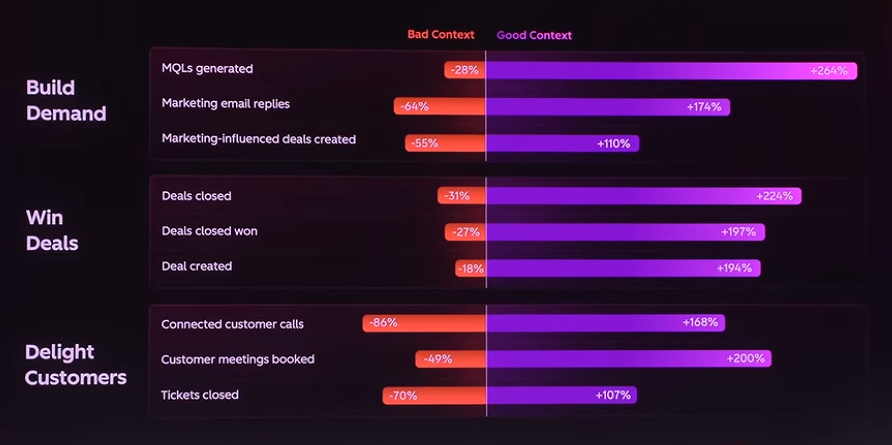
Credit: Screenshot of the HubSpot Spotlight Live from UNBOUND 2026 video.
If companies run their AI on thin, outdated, and often inaccurate context, they see drastically different outcomes:
For marketing (building demand):
- 28% fewer Marketing Qualified Leads (MQLs) generated
- 64% fewer marketing email replies
- 55% fewer marketing-influenced deals created
Sales (win deals):
- 31% fewer deals closed
- 27% fewer deals closed-won
- 18% fewer deals created
Customer Service (delight customers):
- 86% fewer connected customer calls
- 49% fewer customer meetings booked
- 70% fewer tickets closed
Here is what this looks like in reality: an AI agent recommending products that were retired or are no longer available, AI that analyzes your sales pipeline and makes recommendations based on the wrong parameters, and a service support chatbot that repeatedly "resolves" tickets by giving wrong recommendations.
AI Scales Bad Context
It's easy to read these numbers and gloss over the underlying connection: AI scales bad context, so it's better for the company not to use AI at all if it has bad context. Let me explain.
Even though people love to bring up the old saying about software, "garbage in, garbage out," for AI, AI is fundamentally different from software. Software is programmed to do a specific job: it follows a strict If-Then logic. It takes an input, applies the same process every time, and reliably produces the same outcome. If there are errors or the output is not what you expected, you tweak the function or improve your input.
Modern Artificial Intelligence (especially Large Language Models and Machine Learning) is different, as it is probabilistic rather than deterministic, meaning AI generates outputs based on statistical likelihood and patterns rather than executing fixed, hard-coded rules. If it receives "garbage" (e.g., thin or contradictory context), it confidently fills in the gaps with made-up facts or internet averages. This means that if you don't have clear positioning and messaging, it could use your competitors' or completely made-up facts. It could hallucinate awards you never won, make up pricing on the spot, and so on. These are extreme examples, and frontier models are constantly getting better at reducing hallucinations, but the fact is that if your AI runs on bad context, it fills in the gaps somehow.
Another thing to consider is that AI scales bad context. Depending on how you use AI (e.g., are you deploying full agentic systems or bolting it onto existing processes to make them faster), AI might have recommended retired products to thousands of customers before you notice it, or just cost you rewriting time for a sales email that was wrong or a blog article that contained inaccuracies. But the fact is, AI scales your bad context.
Consequently, you keep AI on a shorter leash to avoid mishaps. Instead of using it to score tens of thousands of leads or analyze your marketing campaigns, you only trust it with jobs where a human checks it at every hand-off point. Humans can compensate for bad context (and that is the crux of the problem). Rachel can edit an article and know where to find the facts to double-check AI's output. John knows the context around each of his CRM contacts and instinctively knows which one will close, and which is a waste of time. These types of "human heroics" save the day. But AI doesn't have these heroics; it will make a decision confidently anyway.
Remember: "No AI" is human judgment applied slowly. "Bad context" is wrong judgment applied fast to everything. "Good context" is right judgment applied fast to everything.

8 Lessons Learnt From Using HubSpot For 2 Years As A Digital Marketing Agency
A few days ago, I shared with you the results we have seen from doing Inbound Marketing with HubSpot for two years. Toda …

Low-Impact vs. High-Impact AI Use Cases For GTM & What Sets Them Apart
Once in a while, someone says something, and I think to myself: 'Dang, I wish I would have come up with that!' I had one …

How To Perform A Content Audit Using HubSpot
During the holiday break, I spent a bit of time organizing my basement. I am a naturally organized person, so I am sorry …
No Comments Yet
Let us know what you think